|
| |
Contact Us
Complete
On-line AIT Checklist
-
-
-
-
-
|
A
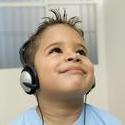
participant MUST have headphone acceptance and cooperation in all sessions
to successfully complete Berard AIT.
If you are
concerned that your child may not tolerate headphones well, please
practice for 1 - 2 weeks prior to beginning your Berard AIT
sessions. |
- Sometimes
children are defensive to a headset but not to being touched on the
head or ears.
Prior
to working on this headphones acceptance procedure, make sure your
child is not (or is no longer) defensive to being touched any place
on the head or around the ears.
- Take care
of this first before proceeding to these next steps:
- Give your
young child daily head massages.
- Rub around
his/her ears to help prepare your younger child for
Berard AIT
Sessions.
- Massaging
your child's head and rubbing their ears will also prepare them
better for wearing the headset during the 20 Berard AIT sessions.
- Practicing
with these things daily should help considerably with acceptance.
-
You may need
to begin by playing some of his/her favorite music over speakers, then
start wearing a headset yourself and announce that Barney, Clifford
(or whoever the favorite character happens to be) is speaking or singing
to you through this little speaker (pointing to the headset).
-
Try for just
a moment to place the headset around the child's neck and shoulder's
or next to the child's ear, if you anticipate resistance.
-
If he/she shows
acceptance and appears interested in listening, go straight for the
ears.
-
Keep the headset
on for just a few seconds to start, then take it off.
-
Ask the child
if he/she wants to hear "Barney" sing more to him/her.
-
Then, as your
child tolerates begin to expose him/her to a wide variety of music
with headphones, starting now. This should include some children's songs,
classical, vocals, bluegrass, country, new age, etc. but not
drums, heavy metal, hip-hop or music with unusual beats or a heavy base
sound or music that is syncopated or polyrhythmic.
-
Be sure to keep
the volume relatively low and have him/her listen just 1 to 3
minutes, a few times per week, to get him/her acclimated to using
a headset. This should be enough to keep him/her in practice for the
headset usage required for Auditory Integration Training.
3.
Ear Health Check
-
Parents
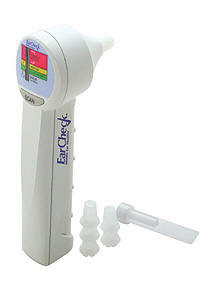
may want to consider purchasing the EarCheck, Middle Ear
Monitor (www.earcheck.com) device.
- This is a parent-friendly and reliable way to check for signs
of ear fluid for children ages 6 months to young adult.
-
The tip
of the device is inserted into the external canal just like an
ear thermometer.
-
The device then checks the fluid level in the
ear.
-
Detailed information about this device
is available at www.earcheck.com.
-
Use every precaution to keep your child well, by not taking him/her
to closed in experiences with crowds of people or sick others, avoiding
parties, school, shopping, etc. would be good during Berard AIT and
the week before Berard AIT!
-
It may be very helpful to use
photos and do social stories around the
Berard AIT listening sessions for young
children who need this.
- Slide Show
About AIT: To help a younger child understand more about AIT, you
may wish to review the on-line Slide Show
About AIT with them.
-
Time Timer:
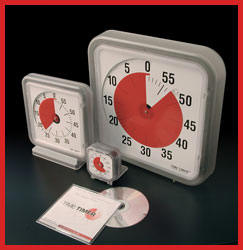
Some parents might purchase of a Time Timer at
to help their child understand the passage of time.
A Time Timer is often used
by Occupational Therapists for those children who have difficulty
with transitioning. By
using this simple visual timing device, children have an idea
when an session will complete, if they don't understand the passage
of time, regardless of age.
-
The child will be sitting on a
comfortable chair, bean bag
chair or other comfortable surface during all Berard AIT
sessions.
-
The music is quite varied,
but mainly popular music
that you may hear on the radio, which has been modulated through the
Berard AIT equipment.
-
During
the Auditory Integration Training sessions the parent is expected
to observe their child, attending to him/her when necessary with
a back, foot and/or hand massage (if this helps the child to stay
put for the 30 minute session)
-
Other
things may be tried as well, but we really want the child
to be LISTENING and responding to the music and not another distraction.
-
Some children want to sway their bodies or get up and dance
-
and that is allowed if needed for a short time. The headphone cord
is only 4 feet so this is restricted to some degree.
-
Children
do not usually find this an unpleasant experience, except
those with a compulsion to move.
Even those kids can quiet down
as the music works on the vestibular system (the movement system)
which can quell their need to seek this elsewhere.
-
The
parent is normally asked to make careful observations of a child between
each session and note observations on any forms provided. The
observations will include any behaviors which are not typical (negative
or positive) or are more or less than expected behaviors.
| |
|