|
| |
Audio Tests for Auditory Integration Training
Contact us for more information about the on-line
Listening Test for AIT.
|
About The OnLine Listening Test
Testing can be done anywhere in the world, using a computer and
headphones!
Please note that Listening tests or
audiograms are NOT required to AIT to be
effective.
We do not require testing for
children with autism, those age of 6 and under, or those who can't cooperative
to obtain a reliable
audiogram or Listening
Test results. Not all cases
who can do testing will require any additional filters to be for AIT to be successful.
The largest clinical study ever done on AIT
for children with autism with 445 participants in 1994 done by the Autism
Research Institute did not use listening test on this population.
Parents should not be
overly concerned if you are the parent of a child who is ineligible
to perform these tests because they have autism, are under the age of five OR because
they may have difficulty participating in the audio tests. The tests
may provide information resulting in a tangible benchmark
as to the effects of
Berard
AIT
-
but are not essential to its success! |
-
The ears must be in good
health and must not have an
active ear infection either just before or during AIT.
-
This is important is there is any concern about recurrent infections,
a history of several ear infections, fluid,
wax, or ear drum and/or middle ear problems.
-
Parents of children who have ear health issues should so use their best judgment for timing the ear
health checks
before AIT if there is a history of many past ear infections or
possible symptoms of an active ear infection.
Determining
AIT Candidacy
From a Listening Test
|
The
most significant information about an individual’s candidacy for Berard
AIT is the participant’s unique, over-all history and current issues of
behavior and learning.
The most significant indicator of AIT
efficacy is in the
results that the
participant experiences in every day life and learning in
the days, weeks and months following AIT. |
-
Listening tests are NOT required for
children age 6 and under or those with an Autism
Spectrum Disorder (ASD or autism) diagnosis or suspected diagnosis to be effective.
A listening test is only done if a Participant can reliably
cooperate.
-
The AIT
Checklist
comprises
about 90% of the candidacy picture for AIT, with the listening tests
is about 10%.
-
In some cases
there be extreme
irregularity in the
audiogram or
Listening Test
that add strongly to the candidacy picture
in some cases, but more often the audiogram will show a milder variation.
-
If
children react strongly with hyper-defensiveness around their ears, obtaining good results with ear checks and
tympanograms can be difficult or impossible and the results will not
be reliable.
About The On-Line
AIT Listening Test For AIT
-
Our new on-line
AIT Listening Test
is available for potential clients and clients.
-
We provide is
online access to candidates who have completed the
AIT Checklist.
-
The
Listening Test must be performed in a sound quiet, but
not a sound proof environment. This is done to
gauge how the Participant hears in a more natural “real
life” setting.
-
The
AIT Listening Test is a simple and subjective measure but requires accurate and consistent participant responses
during the testing to be reliable.
- The Listening
Test creates an audio graph that is a visual measurement of how the individual hears
the ten (10) frequencies tested for Berard AIT at the time
of the test.
-
The
Listening Test is straightforward and can be done in about 10 minutes.
The Participant
follows the written instructions and tests the ten (10) frequencies
in both left and right ear and indicates awareness
of each sound as instructed.
-
The Listening Test checks the ten (10) frequencies of: 250Hz, 500Hz, 750Hz, 1000Hz, 1500Hz,
2000Hz, 3000Hz, 4000Hz, 6000Hz, 8000Hz.
-
The Participant indicates awareness
of each sound as instructed.
-
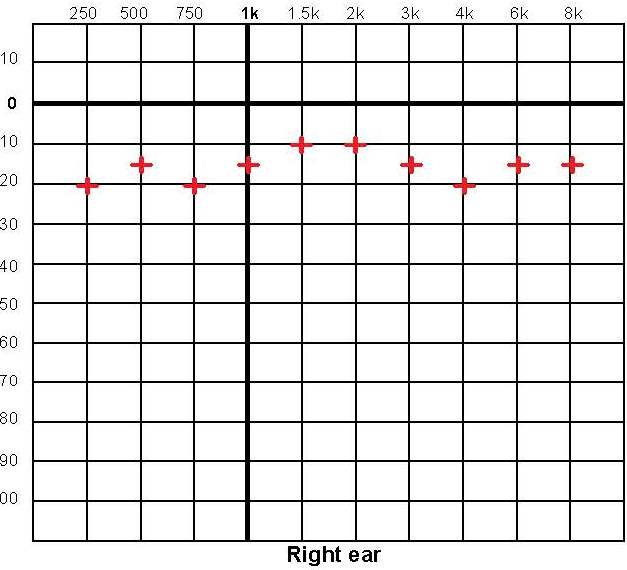
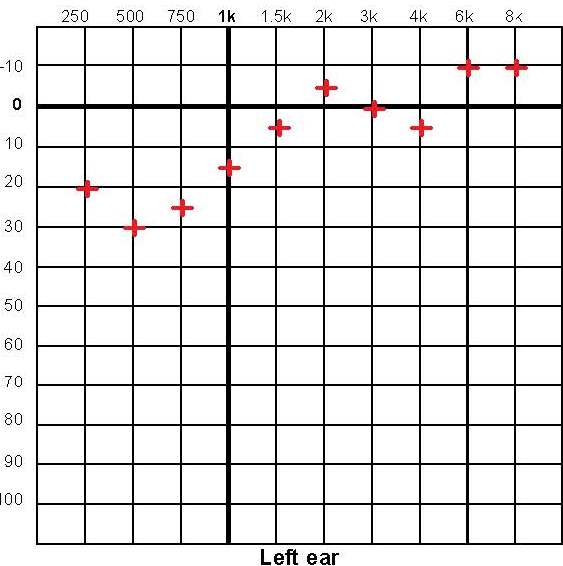
After each ear is tested individually,
an audio graph will provide a graphic display for the hearing
of each ear. See a sample
audio graph
below.
-
The
Listening Test is a simple and subjective measure. It requires accurate and consistent participant responses
during the testing.
-
An
emphasis
can be
placed
upon testing for 750 Hz
and up if the participant’s attention
is not good, for example with younger children above age 7 and who are able to
comply.
-
- Our Listening Test
is used to help determine if
additional frequency filters may be needed
during the
AIT
sessions.
-
Not all
participants will need additional filters even if they are
tested using the Listening Test.
- The main
reason for additional filters is to increase the participant’s comfort
level during AIT and/or to help mute the sounds that the
participant is the most sensitive to, based on hyper-sensitive
peaks in hearing. This filtering will also help to increase their results after
AIT sessions.
- Filtering,
if done, is selected by the AIT
Practitioner and according to the
Berard
AIT protocol.
- Testing with our
on-line Listening test is done before AIT and can also be repeated after
AIT.
-
Shifts seen in listening test are often accompanied by significant
improvement in over-all comfort level, attention, and many improvements
around behavior and learning that continue out for up to 6 months.
- A final
Listening Test can be done after
AIT
is
completed. This can help to document specific changes
that have occurred during the
AIT
sessions,
although changes will continue to occur over time.
-
This
Listening Test may also be repeated
3 to 6 months later as the person's listening skills can continue to
shift over time.
- A post-AIT
Listening Test can be done to check hearing over time and used as a base-line
in the months and years after AIT.
- We usually
will see a narrowing of the variability within each ear’s response
after
AIT
and less variation between the two ear graphs.
-
The
audiogram measures the quietest tones
that the participant can hear.
-
The vertical line to the left of the graph shows the levels of
sound that can be heard.
-
Sound of the
Tones:
The quietest tones are at the top
and the loudest tones
are at the bottom.
-
Pitch Tones:
The lowest pitch tones
are to the left and the higher
pitch tones progress to the right.
-
The
horizontal line
across the top of the graph shows each of the
frequencies tested and include
250Hz, 500Hz, 750Hz, 1000Hz, 1500Hz,
2000Hz, 3000Hz, 4000Hz, 6000Hz, 8000Hz.
-
In a normal audiogram, we
want to see a relatively flat line within the
"0" to "20" range
in both ears. This will indicate
that both ears are hearing each frequency within a normal, comfortable
range. Note: 6000 Hz wanders.
-
Coordination Between Ears:
The audiogram pattern
for each ear will
indicate if the
two ears are working in unison. If the pattern in each ear
is different, then hearing may be distorted.
-
Peaks in hearing between frequencies: These are shown in the negative range (upper portion of graph
above "0" (including marks at -5 and -10) will show a level
of hearing at a particular frequency that cannot be heard by the average
person.
-
Peaks In Hearing: Peaks in hearing will cause stress responses as well as difficulty attending,
irritability, fatigue, hyperactivity and/or distractibility. Peaks
in hearing can be very uncomfortable and/or make it difficult to processing
the other sounds properly. They can also create a state of anxiety for the
individual.
-
Valleys in Hearing Between Frequencies: These are shown in the positive range (lower portion of graph,
below "0"). Peaks and then a valley between frequencies can result
in dramatic auditory processing deficits that effect not only
auditory processing, but other brain and body dysfunctions.
-
Hearing Loss: Hearing below 30
indicates potential hearing loss. If
an obvious hearing loss is indicated by the audiological testing, a
participant will
not be a good candidate for
AIT and
should contact an audiologist for further testing and assessment.
Sample
AIT Listening Test With Audio Graph
- If a Participant
is being tested by an audiologist for an
AIT assessment, other
audiological tests are also sometimes conducted along with the listening
test, but these tests are not required for
AIT.
- Other
audiological tests are for: Laterality, Selectivity, Acoustical
Reflex, Speech in Quiet and Noise and Auditory Speech Reception
Threshold.
- An audiologist
and/or medical practitioner can be used for
ear health checks, doing audiograms, a tympanogram
and for other tests listed. The correct Berard AIT
protocol for obtaining an audiogram used
with AIT must be followed and with testing at all ten (10) frequencies.
| |
|