|
| |
Hyper-hearing,
Hyperacusis or Sensitive Hearing and Berard AIT
Contact Us
Complete
On-line AIT Checklist
by Rosalie
Seymour, SLP/A, Berard AIT Practitioner
 \ \
About
Hyperacute Hearing, Hyperacusis or Sensitive Hearing and Berard AIT
The
condition is poorly understood by audiologists in my experience: there is a
greater appreciation of the condition by
AIT Practitioners than by audiologists, with a few exceptions.
It is not
always clear whether it is an exaggerated response by the nerves of hearing or
whether it is more appropriate to describe it as an exaggerated response by the
listener – in the sense of …”if a leaf falls in the forest and there was nobody
to hear it, was there a sound?..” debate.
Here
are various types of hearing issues from different causes:
-
Response To Loudness:
There is a condition of exaggerated subjective response of loudness by the
ear or the the listener who has an Audiogram or
Listening Test that is within normal limits, i.e. between 0 to 20 dB.
The person still finds certain sounds are abrasive, painful or irritating.
-
Hypersensitive Hearing:
There is a condition of
hyperacute hearing is shown by
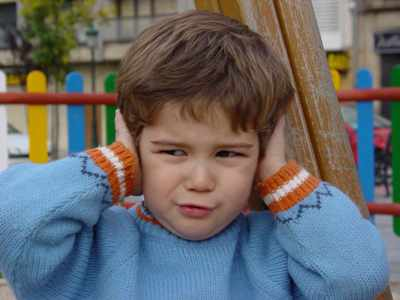
behaviors in children, including covering their ears when certain sounds or
made, or stimming in children with autism. If testing is done with an
audiogram, this is shown by a hearing threshold above the 0 dB line.
Hyperacute hearing is
sometimes called “bionic hearing” and it can occur on certain frequencies or even on all
frequencies. Hearing at hyper levels of -40 dB have been recorded, although most
audiometers only test up to – 10 dB.
-
Children
and adults who experience everyday sounds at a much louder volume than those with ‘normal’
hearing levels are more prone to experiencing sounds as painful, annoying, distracting
or irritating and react accordingly.
-
Everyone can experience
painful hearing. The threshold for pain is normally reached around 120
to 140 dB. The area between the hearing threshold (0 to 20 dB) and the pain
threshold (usually 120 to 140 dB) is called the person’s “dynamic
range”. That is the range of loudness between threshold and pain in
which the ear, or the person can hear and process sound for meaning.
-
Acoustic Reflex Spasm:
There is a mechanism for
protecting the hearing called the “acoustic reflex”, which comes into action
when sounds reach the loudness of 80 to 95 dB, although this can vary per person.
The tympanic and stapedius muscles of the ossicular chain, the
little bones of the middle ear, then clench tightly, impeding the passage of
sound to the inner ear. This reflex response thereby protects the inner ear’s delicate
cells (cochlear hairs) from damage caused by loud sounds. One can experience sounds at this
level as ‘loud’ even ‘too loud’ but not painful.
-
Painful Hearing:
There is the kind of
painful hearing described for people with hearing loss, as tested in the
moderate to profound range – usually from 50 to 90 dB losses or greater. In
this type of painful hearing there is cochlear involvement, or inner-ear and nerve hearing loss involved.
These people need sounds made louder before they can begin to hear them, but
when they do begin to hear – at threshold – the sound is
immediately also painful. When the nerves of the cochlea are affected
the pain threshold is reached more quickly, For example, a person begins to
hear the frequency at 60 dB but experiences pain at 65 dB. This means
their dynamic range is only 5 dB as compared to the normal 100 dB or
thereabouts. This is what makes adjusting to hearing aids so difficult.
Although all of these conditions involve poor auditory
processing, the causes are not from the same origin.
We know
that these conditions are neurological (cochlea to brain) not peripheral (outer ear and
middle-ear). Although
Dr. Berard
said that in the case where little muscles of the middle ear, the acoustical
reflex muscle, go
into spasm, thi can cause painful hearing.
The causes of
hyper-hearing, hyperacusis or sensitive hearing
or
painful hearing are different and not clearly known.
-
It is
known that nerve damage can cause painful hearing both in brain damage or
cochlear damage.
-
It has
known that nerve hearing loss can cause painful hearing.
-
It is known that
hyper sensitivity in general (sensory integration issues) can also be
associated with painful hearing. If a person is hypersensitive in one
sensory domain, it is likely they will also be hypersensitive in other
sensory domains, since it is the processing organ not the sensory organ
that is operating defectively.
-
Nutritional problems and
neurobiological differences, can be at the root of many painful hearing
cases. It has been documented that low magnesium levels especially
can lead to hyper-sensory problems. The supplementation and even
mega-dosing with magnesium and vitamin B6, together with zinc and calcium,
can over a period of one to three months cause a reduction in the
pain of painful hearing.
Addressing Hyperacute
Hearing, Hyperacusis or Sensitive Hearing with Auditory Integration
Training
-
Berard AIT
has proven itself effective for many cases and types of hyper-sensitive
hearing, with lasting benefits being documented.
-
The benefits of
Berard AIT alone, if
there is a metabolic issue left
untreated, could be limited.
-
Metabolic assessment and
supplementation as mentioned above can be very effective for some. This is a
long-term treatment.
-
When there sensory processing
issues, a neurobiological assessment should also be performed to
determine if a metabolic problem has caused the issue and still needs to be
resolved.
Ear Protectors
and Hyperacute hearing,
Hyperacusis or Sensitive Hearing
There is a tendency for some with painful
hearing to wear ear protectors. This has been strongly recommended against by
Dr. Berard, since it
exacerbates the problem. The relief is short-term but the negative effects
lasting.
When person doing AIT treatment
has to expose themselves to sounds that cause them great distress, ear
protectors may be used
briefly, for very brief periods
only or it will likely worsening the situation.
| |
|