Autism Study 2002:
Auditory Integration Training and It's
Effectiveness with Autism
Read
More
Clinical Research on AIT
Contact Us
Complete
On-line AIT Checklist
written by Rosalie
Seymour, SLP/A, Berard AIT Practitioner and Maoilíosa Ó Rathaille, B.A., M.Sc., C.Stat., Lecturer in
Mathematics and Statistics, Waterford Institute of Technology
|
"The results of this study indicate that a course of AIT is
likely to have significant beneficial effects for children with a diagnosis
of autism. These results are compatible with many other studies into
the effects of AIT on Children with Autism." |
Two groups of children with autism were studied; a control
group (n = 8) and an experimental group (n = 15)
The control group was made up of children
who had a diagnosis of autism, who did not receive AIT. The
experimental group were made up of a comparable group of children
with a diagnosis of autism who did receive AIT.
The ATEC gives a Total score, as well as sub scores
for
- Speech,
- Sociability,
- Cognitive / Sensory awareness, and
- Health-Physical-Behavioral issues.
The ABC has a Total score, as well as sub scores for
- Hyperactivity,
- Irritability,
- Lethargy,
- Stereotypy and
- Inappropriate Speech
In both these checklists, a high score indicates greater
severity while a low score indicates a milder degree of difficulty.
Comparing The Two Groups Pre-AIT:
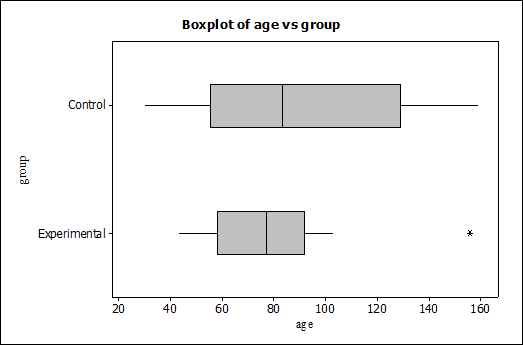
In this section (see Figures 1-4 and Tables 1-4 below),
the two groups are compared to discover whether they were evenly comparable.
The results show that they were found to be very similar
in terms of age and E2 diagnostic scores at the commencement
of the trial period.
(NOTE ON READING BOXPLOTS: each of the
four sections indicates 25% of the sample. The boxed two middle sections
each represent the 25% nearest the midline, and the lines each represent 25%
on the outer ends of the sample. A star indicates an out-lier).
Figure 1: Age
Figure 2
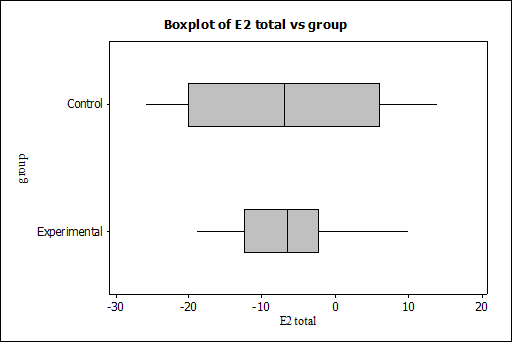
Table 2: Comparison of E2 Total Scores
|
E2 total
|
Control
|
Experimental
|
Mean difference
|
-0.5
|
|
Sample size
|
7
|
14
|
t-value
|
-0.1
|
|
Mean
|
-7.3
|
-6.79
|
P-value
|
0.92
|
|
Standard deviation
|
14.8
|
7.91
|
Significant (5%)
|
No
|
Table 3: Comparison of E2 Speech
|
E2 speech
|
Control |
Experimental |
Mean difference |
0.21 |
|
Sample size |
7 |
14 |
t-value |
0.17 |
|
Mean |
1.43 |
1.21 |
P-value |
0.868 |
|
Standard deviation |
3.46 |
2.36 |
Significant (5%) |
No |
Table 4: Comparison of E2 Behavior
|
E2 Behavior
|
Control |
Experimental
|
Mean difference
|
-0.71 |
|
Sample size |
7 |
14 |
t-value |
-0.17 |
|
Mean |
-8.7 |
-8.0 |
P-value |
0.867 |
|
Standard deviation
|
12.6 |
6.97 |
Significant (5%)
|
No |
So it can be seen that the Experimental Group and the Control
Group were comparable in terms of age and diagnostic severity as measured by
the form E2.
Comparison of the Groups - ATEC and ABC
Baseline Scores
In addition, both groups
started from the same baseline scores in terms of ATEC and ABC scores.
As can be seen in Figures 5 and 6 and in Tables 5 and 6 below, there is
no statistical evidence of any differences between the groups for both
the initial ATEC total scores and the initial ABC total scores.
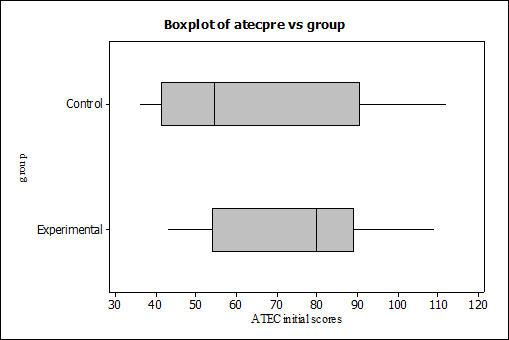
Table 5: Comparison of ATEC initial scores
|
ATEC initial
|
Control
|
Experimental
|
|
|
|
Sample size
|
8
|
15
|
W-value
|
79.5
|
|
Median
|
54.5
|
80.0
|
P-value
|
0.3017
|
|
Difference between medians
|
-12.5
|
|
Significant (5%)
|
No
|
Figure 6
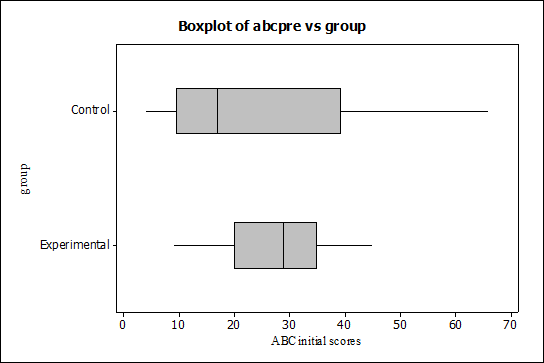
Table 6: Comparison of ABC initial scores
|
ATEC initial
|
Control
|
Experimental
|
|
|
|
Sample size
|
8
|
15
|
W-value
|
79.5
|
|
Median
|
54.5
|
80.0
|
P-value
|
0.3017
|
|
Difference between medians
|
-12.5
|
|
Significant (5%)
|
No
|
The Intervention
Each of the children assigned to the experimental group (n=
15) received a ten-day course of
Auditory Integration Training over a
period of 5 months. The AIT was performed by a certificated AIT practitioner
and trainer in the method, using an Audiokinetron.
No extra filters were set as none of the participants were
able to complete the Berard Listening Tests. The Berard Protocol for
administration of AIT was followed for each of the participants. Outside of
AIT, the participants continued with their regular programs.
The children of the control group continued with their
regular programs, but did not receive any specific music nor listening
training during this period.
The post-AIT checklist scores were taken from forms completed
4 months after AIT was done for each child, and 4 months after the initial
pre-checklists were completed in the case of the control group.
Result of Pre-Post Score Changes
Comparison
In comparing the changes in the ATEC scores and the ABC
scores for the two groups, after the experimental period, the statistical
evidence suggests that the there is a significant difference for the ATEC
scores (see Figure 7 and Table 7) and an almost significant
difference for the ABC scores (see Figure 8 and Table 8), with the
experimental group showing more benefit in both cases. These changes
being significant were probably due to AIT, and cannot be attributed to
chance.
Figure 7.1
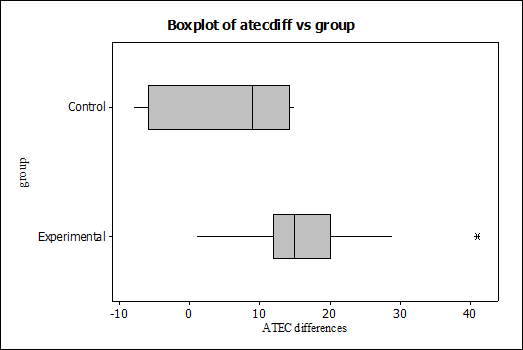
Table 7: Comparison of ATEC pre-post score differences
|
ATEC differences
|
Control
|
Experimental
|
Mean difference
|
-10.3
|
|
Sample size
|
6
|
15
|
t-value
|
-2.16
|
|
Mean
|
5.7
|
16.0
|
P-value
|
0.044
|
|
Standard deviation
|
10.3
|
9.79
|
Significant (5%)
|
Yes
|
Figure 8
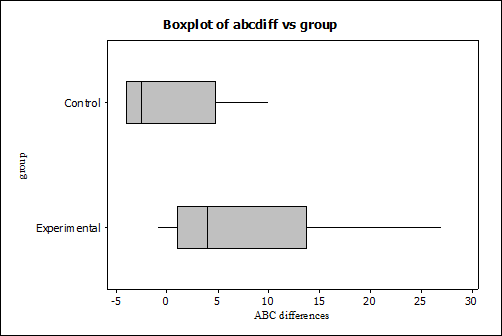
Table 8: Comparison of ABC pre-post score differences
|
ABC differences
|
Control
|
Experimental
|
Mean difference
|
-8.07
|
|
Sample size
|
6
|
14
|
t-value
|
-2.03
|
|
Mean
|
0.0
|
8.07
|
P-value
|
0.058
|
|
Standard deviation
|
5.62
|
8.94
|
Significant (5%)
|
No
|
These results indicate that a course of Auditory Integration
Training (AIT) resulted in some significant improvements for a group of
children with autism. These changes were not observed in the comparable
group of children with autism who did not receive AIT.
These changes were more significant for those behaviors
measured by the Autism Treatment Evaluation Checklist (ATEC), which
has subscores for
Speech,
Sociability,
Cognitive / Sensory awareness
Health-Physical-Behavioral issues.
The results of this study indicate that a course of AIT is
likely to have significant beneficial effects for children with a diagnosis
of autism. These results are compatible with many other studies into
the effects of AIT on Children with Autism.
References available on request from the
author. |